
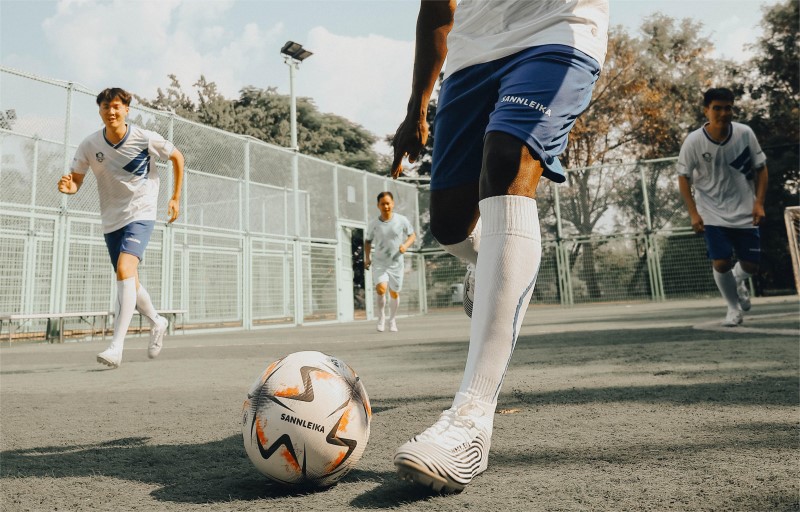
The Hidden Variable in Passing Accuracy Training: How Soccer Ball Roundness Affects Short Pass Success
When a coach analyzes a failed short pass during an intensive training session, they almost always look at the player. They check the body positioning, the ankle lock, and the vision of the midfielder. However, elite technical directors know that a hidden variable often distorts these metrics: the geometry of the ball itself. Recent field data indicates that when a soccer ball’s roundness deviates by more than 1.5%, the placement error of a standard 5-meter short pass can expand by over 30%. This guide explores how ball asymmetry undermines player development and why choosing the right gear is vital for precision training.
1. The FIFA Standard: What “Roundness Tolerance” Really Means
To understand the mechanics of a true pass, we must look at how professional bodies measure a sphere. FIFA utilizes a rigorous testing process where a ball’s diameter is measured at 45 distinct points. The difference between the largest and smallest diameters determines the roundness tolerance.
-
FIFA Quality Pro Standard: Requires a roundness tolerance of ≤ 1.5%. This strict threshold ensures the ball responds identically no matter which panel makes contact with the boot.
-
The Low-End Reality: Budget, poorly constructed, or heavily warped stitched balls frequently exhibit a deviation greater than 3%.
Consequently, a 3% deviation means the ball is no longer a perfect sphere; it is effectively a subtle oval. When a player strikes this distorted shape, the contact point shifts unpredictably, turning a fundamentally perfect passing motion into an inaccurate turnover.
2. The Physics of the Roll: Why Asymmetry Multiplies Error
In short-passing drills, the ball spends most of its time interacting with the grass. A ball with a high roundness deviation creates an uneven contact patch with the ground.
-
The “Hops” and “Skips”: As an asymmetrical ball rolls, its center of gravity shifts up and down. This causes microscopic skips that slow the ball down prematurely and alter its directional vector.
-
The 30% Error Multiplier: Over a short 5-meter distance, these microscopic skips accumulate. Consequently, a pass intended for a teammate’s trailing foot can drift up to 15 centimeters off-target.
Therefore, instead of a smooth, predictable roll, the receiving player is forced to adjust to a skipping object. This delays their transition into the next play and ruins the tempo of the drill.
3. The Thermo-Bonded Solution: Guaranteed Predictability
To eliminate this variable from your academy or club training, hardware engineering must move past traditional hand-stitched seams. SANNLEIKA utilizes an advanced thermo-bonding process to lock in geometric perfection.
-
Seamless Spherical Curing: By fusing the panels inside a high-pressure, perfectly spherical mold, the ball achieves an incredibly low roundness tolerance that easily beats standard benchmarks.
-
Consistent Flight Trajectory: Without the external recess of deep stitched grooves, aerodynamic drag is evenly distributed. This yields a highly reliable flight path through the air and a true roll on the pitch.
Consequently, when a player makes a mistake, the coach can confidently attribute it to technique, not a faulty piece of equipment.
Conclusion: Control the Variables, Elevate the Team
In elite football development, you cannot afford to let your equipment lie to your players.
Stop forcing your squad to train with warped, inconsistent gear that punishes good technique. Instead, invest in the precision of thermo-bonded training tools engineered with a professional-grade roundness tolerance soccer ball profile. Consequently, your short-game drills will become sharper, your players will develop better first-touch habits, and your passing success rates will rise. Experience the power of geometric predictability today. Give your team a ball that rewards perfection.





Add comment