
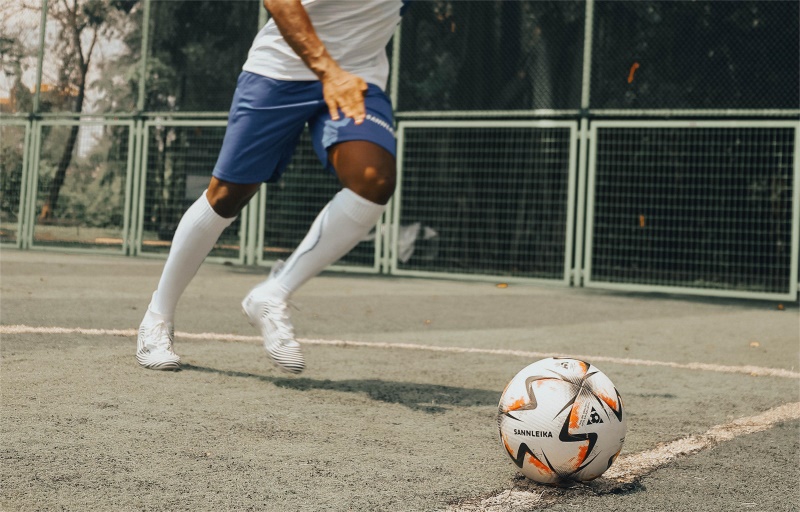
The “Foundation” Ball: How Beginners Can Choose the Most Cost-Effective Starter Model
Starting a football journey in a school or beginner’s clinic requires equipment that can survive the daily grind of the pitch. For new players, a high-performance match ball is often less important than a reliable tool that withstands constant use. Consequently, selecting a standard training football for practice should focus on structural integrity and air retention. This guide outlines the essential features of a starter ball that prioritizes long-term durability over soft touch. We help you find the perfect balance of price and performance for your first season.
Durability First: The Essentials of a Starter Ball
For schools and youth programs, the most important metric is how many months a ball can last on asphalt or rough grass. A professional standard training football for practice must be “tough” enough to handle repeated kicks and abrasions.
-
Wear-Resistant PU Surface: Synthetic Polyurethane (PU) offers a much longer lifespan than cheap PVC. Furthermore, it resists scuffs and scratches during heavy use on various surfaces.
-
Machine-Sewn Construction: This stitching method is cost-effective and provides consistent seam strength for high-repetition drills. Consequently, it is the ideal choice for training environments where volume matters more than advanced aerodynamics.
-
Butyl Bladder: Unlike latex, butyl rubber holds air for weeks without leaking. Furthermore, this means coaches and students don’t have to spend time inflating balls before every session.
Consequently, these features ensure the ball remains functional throughout a full academic year. Therefore, investing in “toughness” saves money by reducing the frequency of equipment replacement.
The Beginner’s Configuration Checklist
When browsing for an entry-level standard training football for practice, look for these specific technical specifications:
-
Material: 100% Abrasion-resistant PU (Avoid thin PVC wrappers).
-
Lining: 2-3 layers of polyester/cotton cross-lamination for shape retention.
-
Seams: Tight machine stitching to protect the internal thread from fraying.
-
Air Valve: Dual-lock system to prevent dirt entry and pressure loss.
Pro Tip: For beginners, “durability” is your best friend. A ball that keeps its shape and air pressure is far more useful for learning basic techniques than a soft, fragile match ball.
Starter vs. Pro: What Are You Paying For?
| Feature | Starter Training Model | Professional Match Model |
| Surface | Thick, Tough PU | Thin, Reactive PU / Foam |
| Stitching | Machine-Sewn (Reliable) | Hand-Sewn or Thermally Bonded |
| Bladder | Butyl (High Air Retention) | Latex (High Elasticity) |
| Maintenance | Low (Inflate once a month) | High (Inflate daily) |
| Priority | Durability & Value | Speed & Flight Precision |
Consequently, the starter model offers a much better Return on Investment (ROI) for educational settings. Furthermore, the slightly firmer feel helps beginners develop proper striking power and foot control. Therefore, “usable life” remains the top priority for school-based procurement.
Conclusion: Building Skills on a Solid Foundation
Every football star began their career with a simple, reliable ball that didn’t quit.
Stop worrying about expensive “professional” features that won’t survive a week on a concrete playground. Instead, embrace the rugged reliability of a standard training football for practice designed for the daily hustle. Consequently, your players can focus on mastering the basics without equipment failure holding them back. Experience the value of industrial-grade durability for your school or club today. Your athletes deserve a ball that is as hardworking as they are.






Add comment