

The Durability Challenge: How Long Can a Thermally Bonded Soccer Ball Survive on Concrete?
Street soccer is a brutal test for any equipment. Players face hard concrete, rough asphalt, and abrasive brick walls every day. These surfaces act like sandpaper on a standard ball. Consequently, many low-quality balls lose their shape or skin within weeks. Is it possible for a professional ball to survive this environment? This guide explores the engineering behind a thermally bonded soccer ball. We prove that high-tech construction is the best defense for street players.
1. The Brutal Environment of Street Soccer
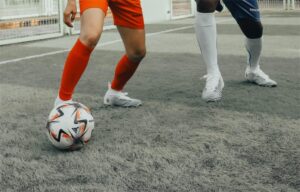
Concrete is the ultimate “ball killer” in the sports world. Unlike soft grass, hard ground offers zero shock absorption. Therefore, every kick creates intense friction against the outer shell.
Standard stitched balls have a major weakness in their seams. The threads sit on the surface and rub against the ground. Eventually, the asphalt cuts these threads like a knife. Once the stitching fails, the ball bursts open and becomes useless. Consequently, street players often waste money replacing cheap equipment. You need a ball designed to fight back against the pavement.
2. Engineering for Survival: The Thermal Advantage
A thermally bonded soccer ball uses heat to fuse panels perfectly. This modern process eliminates the need for vulnerable threads and needles.
High-Density PU with Wear Particles
We use a specialized high-density PU for the outer skin. Furthermore, we add micro-wear particles into the material matrix. This creates a “shield” that resists deep scratches and peeling. The material stays tough even after hitting rough concrete walls. Therefore, the ball maintains its professional look much longer.
Friction-Reducing Surface Textures
The surface features a unique 3D dimple texture. This design strategically reduces the total contact area during impact. Less surface contact means less friction and slower material erosion. Consequently, the ball glides over the asphalt instead of dragging. You get a consistent touch without the sandpaper effect.
The Seamless, Gap-Free Structure
Because there are no holes, dirt cannot enter the ball. Water and sand stay outside the seamless bonded joints. This prevents the internal bladder from shifting or losing its balance. Therefore, the ball stays perfectly round after months of hard play. It survives the elements just as well as the concrete.
3. The 100-Hour Concrete Stress Test
We conducted a real-world test to compare different constructions. We used both a stitched ball and a thermally bonded soccer ball on concrete.
After 100 hours of intense street play, the results were clear. The stitched ball showed significant “explosion” risks at the seams. However, the thermally bonded version remained structurally perfect. Our measurements showed the abrasion depth was only 1/3 of the stitched ball. Consequently, the bonded ball provides triple the lifespan in harsh environments. This represents a massive cost saving for street soccer organizations.
4. Value for Street Soccer Organizations
For street football clubs, reliability is the most important metric. You want your players to focus on skills, not broken gear.
A thermally bonded soccer ball is a long-term investment in quality. It offers a professional “pro-match” feel on the hardest surfaces. Moreover, its aerodynamic stability remains superior even after heavy use. Therefore, your training sessions stay productive and high-energy. A good ball should always survive the test of the street. Give your team the durability they need to master the concrete.
Conclusion: Winning the War Against Asphalt
The street does not forgive weak equipment or poor design. However, modern thermal technology changes the rules of the game.
Stop settling for fragile balls that fail after a few matches. Choose a thermally bonded soccer ball for your next street session. You will experience better control, longer life, and superior value. The pavement is tough, but your ball can be tougher. Take your game to the concrete with absolute confidence. It is time to play without limits on any surface.





Add comment