
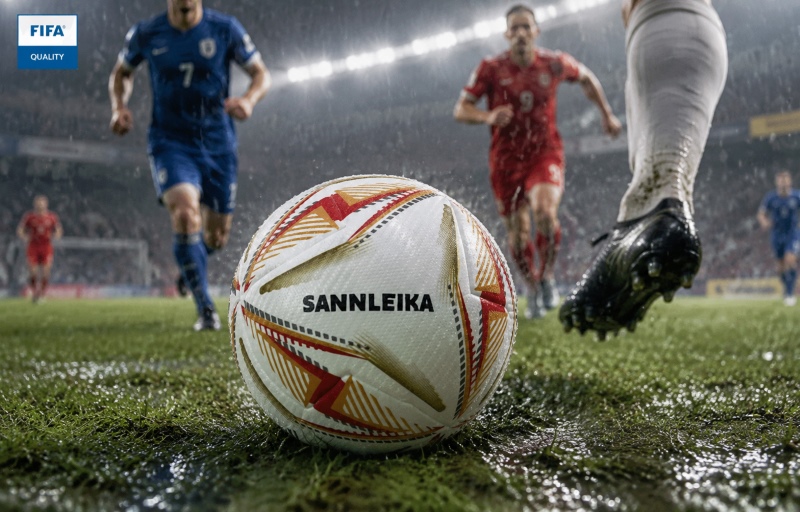
Rainy Weather Performance of Thermally Bonded Soccer Balls: The “Stability Code” in Wet Conditions
During rain-soaked matches and training sessions on wet turf, a football’s physical properties undergo severe testing. Professional coaches, equipment managers, and sports brand buyers frequently raise a critical performance question: “Can a thermally bonded soccer ball truly maintain its flight trajectory, responsiveness, and weight stability in wet conditions, and how dramatic is the water absorption difference compared to traditional hand-stitched or machine-stitched balls?”
The technical answer lies in the structural engineering of modern match balls. Traditional stitched balls rely on thousands of micro-punctures created by needles, forming direct pathways for water penetration. In contrast, seamless thermal bonding technology uses advanced polyurethane adhesives and heat pressure to fuse casing panels into a unified, impervious shell.
This technical guide evaluates the engineering mechanisms, water absorption data, and real-world performance metrics that make the thermally bonded soccer ball the undisputed benchmark for all-weather play.
1. Why Thermal Bonding Provides a Decisive Advantage in Wet Conditions
To understand why a thermally bonded soccer ball excels in heavy rain, one must look at the dual-layer material architecture that seals the ball against moisture ingress:
Hydrophobic Outer Coating Layer
High-grade match balls incorporate a specialized Polyurethane (PU) or Thermoplastic Polyurethane (TPU) outer shell treated with a hydrophobic surface coating. This microscopic layer creates a high contact angle against water droplets, causing rain to bead up and roll off instantly rather than clinging to the panel surface or penetrating seams.
Molecular-Chain Thermal Melt Sealing
Beneath the outer PU layer, high-temperature thermal bonding activates specialized hot-melt adhesive layers. The polymer chains cross-link to form an airtight and watertight bond along panel perimeters. This eliminates needle holes, locking out moisture and protecting the internal carcass and butyl/latex bladder from waterlogging.
2. How Rain and High Humidity Affect Match Dynamics and Player Safety
Playing with a waterlogged football fundamentally alters the game of football, its biomechanics, and safety. Under 85% relative humidity or heavy rainfall, the contrast between construction methods becomes immediately noticeable on the pitch:
| Performance Factor | Impact on Match Performance |
|---|---|
| Weight Stability | Traditional stitched balls can absorb water and increase weight by up to 12%. The additional weight affects player control, increases foot fatigue, and may reduce passing accuracy. |
| Surface Friction and Ball Control | Seamless thermal-bonded panels maintain a consistent surface texture. This improves grip, touch control, and handling performance in different weather conditions. |
| Internal Structure Protection | Thermal bonding technology reduces the risk of bladder and outer casing separation. As a result, the ball maintains structural integrity during repeated high-impact use. |
| Flight Consistency and Aerodynamics | Stable internal construction helps maintain consistent weight distribution. This reduces unpredictable drag and improves ball trajectory during long passes and shots. |
-
Elimination of Uncontrolled Slippage: When traditional balls absorb water, the outer leather/synthetic panels become slick and heavy, causing frequent foot slipping during passing and shooting. Seamless thermal bonding retains consistent surface texture and friction coefficients.
-
Prevention of Casing Delamination: High-speed impacts on wet turf force water through stitched seams into the interior layers. Over time, trapped hydraulic pressure causes internal layer separation (delamination). Thermally bonded structures resist hydraulic pressure, ensuring long-term structural integrity.
3. Comparison: Thermally Bonded Soccer Balls vs. Stitched Soccer Balls in Water Absorption
To qualify for FIFA Quality Pro accreditation, match balls must undergo rigorous laboratory testing, including water immersion tests. The table below illustrates the stark empirical differences:
| Technical & Performance Parameter | Traditional Hand/Machine-Stitched Ball | High-Grade Thermally Bonded Soccer Ball |
| Seam Construction | Exposed needle holes & thread gaps | Seamless, heat-fused panel joints |
| Water Absorption Rate (FIFA Test) | 8% to 12%+ weight increase | Less than 0.5% to 1% weight increase |
| Weight Consistency in Rain | Becomes significantly heavier (>480 g) | Remains within standard match weight (420-445 g) |
| Rebound & Spherical Stability | Rebound degrades as the interior foam soaks | Consistent rebound height (135-155 cm) |
| Primary Recommended Application | Dry weather, indoor, or casual training | All-weather professional matches & rainy climates |
4. Procurement Guidelines for Rainy Climates and All-Weather Training
Sports organizations, club academies, and equipment distributors operating in coastal or high-rainfall regions should prioritize specific technical metrics during custom soccer ball procurement:
-
Verify International Low Water Absorption Standards: Ensure the manufacturer supplies FIFA Quality Pro or equivalent laboratory test reports proving a water absorption index below 1%.
-
Select Multi-Layer Carcass Construction: Look for thermal balls constructed with high-density EVA foam backing beneath the PU shell. EVA foam features a closed-cell architecture, providing a soft touch while naturally repelling moisture absorption.
-
Specify Vulcanized Butyl Bladders: Pair seamless outer shells with high-retention butyl bladders to maintain optimal air pressure over extended multi-day rain tournaments.
Technical Summary
Choosing a thermally bonded soccer ball is the ultimate technical safeguard against weather-induced performance degradation. By replacing stitch lines with molecular-level heat fusion and hydrophobic surface coatings, thermal bonding restricts water absorption to minimal levels (<1%). This engineering approach ensures true rebound, stable flight trajectories, and player safety regardless of pitch conditions.
SANNLEIKA specializes in high-precision thermal bonding technology, custom soccer ball manufacturing, and OEM/ODM solutions for international sports brands and professional leagues.


Add comment