
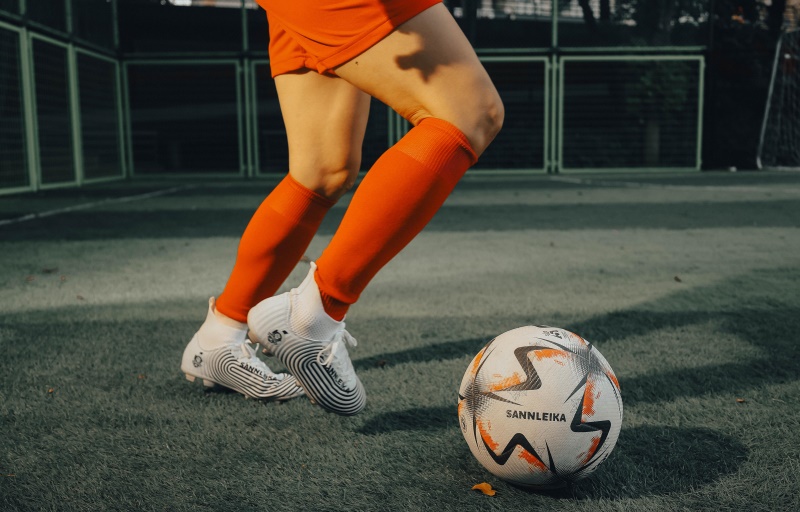
The Language Beneath Your Feet: How a Premium PU Training Soccer Ball Becomes Your “Silent Coach”
In the philosophy of the beautiful game, a soccer ball is far more than a piece of equipment; it is an extension of the player’s nervous system. From the first touch of a young prodigy to the clinical finish of a professional, the dialogue between the boot and the ball determines the limits of skill. While match balls often capture the glory of the stadium lights, it is the PU soccer ball for training that does the heavy lifting in the shadows of the practice pitch.
A high-quality training ball doesn’t just endure thousands of kicks; it speaks to the player. Through consistent weight, predictable bounce, and tactile feedback, it provides an honest critique of every movement. It doesn’t shout, yet through every roll and rebound, it tells you if your power was sufficient, your angle precise, or your touch too heavy. This article explores how the engineering of a PU training ball facilitates the “muscle memory” required for technical mastery, acting as a silent, relentless mentor on your journey to excellence.
1. The “Tactile Dialogue”: Why PU is the Language of Skill
The material of a soccer ball dictates its “personality.” In the realm of training, Polyurethane (PU) has emerged as the gold standard because of its unique ability to mimic the performance of professional match balls while offering superior durability.
Softness Meets Responsiveness
Unlike cheaper PVC balls, which can feel plastic-like and “hard” on the foot, a PU soccer ball for training offers a sophisticated softness. This is critical for developing a “soft touch.”
-
Energy Return: When you trap a PU ball, the material absorbs a portion of the kinetic energy, allowing for a “damped” response. This helps the player learn exactly how much resistance to provide with their foot.
-
The “Stick” Factor: Quality PU has a natural grip. This ensures that during high-speed dribbling, the ball stays closer to the boot, allowing the player to feel the subtle micro-adjustments needed to change direction.
Building Honest Muscle Memory
Muscle memory is built on repetition, but repetition is only valuable if the feedback is consistent. If a ball behaves differently every time you strike it, your brain cannot “calibrate” the movement. A precision-engineered PU ball ensures that if you hit the “sweet spot,” the result is identical every time. This consistency turns the ball into an honest teacher.
2. Predictable Physics: The Foundation of Confidence
To advance technically, a player must be able to anticipate the ball’s behavior before it even arrives. A professional PU soccer ball for training is designed to eliminate the “randomness” associated with low-tier equipment.
Consistent Sphericity and Flight
The “Silent Coach” provides lessons in aerodynamics. By using high-quality internal bladders (typically butyl for air retention or latex for bounce) and reinforced carcasses, a training ball maintains its perfect roundness even after months of impact.
-
The Lesson in Long Passing: When you strike a long ball, you need to know that any “wobble” in the air is a result of your technique, not a defect in the ball’s shape. A true-flight PU ball tells the truth about your follow-through.
-
The Lesson in Crossing: A balanced ball allows a player to master the “curve” or “dip.” If the ball’s center of gravity is off, the player will never learn the subtle art of the knuckleball or the curling cross.
The Precision Bounce
A training session involves thousands of rebounds. If a ball is too “bouncy” or too “dead,” it ruins the timing of volleys and half-volleys. A premium training ball is calibrated to FIFA-standard rebound heights, ensuring that the rhythm you learn on the training ground translates perfectly to the match on Saturday.
3. Durability: The Loyalty of the Silent Mentor
A coach who disappears halfway through a session is of no use. Similarly, a training ball must be built to withstand the “grind.”
The Multi-Layered Defense
A professional PU soccer ball for training is a marvel of layering. Beneath the outer PU skin lie multiple layers of polyester and cotton linings bonded with natural latex.
-
Shape Retention: These layers act as the “skeleton” of the ball, preventing it from becoming “egg-shaped” after thousands of high-velocity strikes against goalposts or fences.
-
Water Resistance: Modern training balls often feature “Seam-Sealing” or high-density stitching that prevents water uptake. A ball that gains weight in the rain is no longer a coach; it is a burden. By staying light and dry, the PU ball ensures your training intensity remains high regardless of the weather.
Abrasion Resistance
Training often happens on various surfaces—natural grass, artificial turf, or even hard dirt. The outer PU layer is treated with an anti-abrasion coating, ensuring that the “texture” (which provides the grip) isn’t worn away in the first month.
4. Feedback Mechanics: Learning from Every “Mistake.”
The greatest gift a PU soccer ball for training gives a player is “immediate correction.”
-
The “Mis-hit” Vibration: Because PU is more resonant than cheap synthetics, a mis-hit strike sends a clear vibration up the player’s leg. The ball is saying, “You caught me too low” or “Your ankle wasn’t locked.”
-
The Sound of Success: Experienced players know the “thud” of a perfect strike. A well-constructed training ball produces a crisp, clean sound when struck correctly, providing an auditory cue that reinforces good habits.
-
Touch Feedback: In close-quarters drills, the “give” of the PU surface tells the player if their passing weight was appropriate for a 5-yard vs. a 15-yard transition.
5. Conclusion: Investing in Your Technical Future
In the journey to become a better player, you cannot afford “noise.” You need clarity. You need a ball that honors your effort with precision and punishes your mistakes with honest feedback.
Choosing a premium PU soccer ball for training is not just about buying a piece of sports gear; it is about hiring a silent coach who will be with you for every solo drill, every team practice, and every sunrise session. When you respect the “language” of the ball, the ball will, in turn, teach you how to master the pitch. It is the most loyal partner you will ever have—a silent mentor that helps you find the professional within.






Add comment