

How Machine-Stitched PVC Footballs Cut Replacement Costs
For schools, football academies, and amateur leagues, buying durable training footballs for schools is not simply about finding the lowest unit price. When dozens or even hundreds of players use the same footballs every week, seam failure, surface abrasion, air loss, and shape deformation can quickly increase replacement costs. Machine-stitched PVC footballs provide a practical solution by combining reinforced stitching, abrasion-resistant PVC surfaces, and reliable shape retention for frequent training.
The real value of a training football should therefore be measured over its entire service life—not only by its initial purchase price. A ball that costs slightly more but lasts through more training sessions can deliver a much lower cost per use.
Why Football Replacement Costs Add Up for Schools and Academies
Football equipment experiences considerably more wear in institutional training environments than it does during occasional recreational use.
A school may have several PE classes using the same equipment throughout the week. A youth academy can run multiple training sessions every day. Amateur leagues may also use the same batch of balls for practices, warm-ups, and matches.
This creates several common equipment problems.
High-Frequency Training Accelerates Wear
Repeated kicking, passing, dribbling, shooting, and ball retrieval expose the outer surface to constant friction and impact.
When footballs are used on artificial turf, hard ground, asphalt-adjacent areas, or rough outdoor pitches, surface abrasion can become particularly noticeable.
For procurement teams, this means that a football’s durability directly affects the annual equipment budget.
Seam Damage Can Shorten Service Life
The seams connect the football panels and help maintain the overall structure of the ball.
Weak or inconsistent stitching can gradually loosen under repeated impacts. Once the stitching begins to separate, the football may lose its shape or become unsuitable for structured training.
This is why reinforced machine stitching is an important consideration when selecting durable training soccer balls for high-frequency use.
Shape Deformation Affects Training Quality
A football is expected to maintain a predictable shape during passing, shooting, and ball control exercises.
A heavily deformed ball can produce inconsistent flight and bounce behavior. For technical training, this can affect both player development and the quality of drills.
Replacing damaged footballs also means additional procurement, inventory management, and disposal work for schools and academies.
How Machine Stitching Improves Football Durability
One of the main advantages of machine-stitched construction is production consistency.
During manufacturing, controlled machine stitching creates closely spaced and relatively uniform seams across the football panels. This helps create a stable panel structure that can withstand repeated impacts during everyday training.
Reinforced Machine-Stitching for Frequent Use
The stitching plays an important role in holding the panels together.
Compared with footballs designed primarily for occasional casual play, a properly constructed machine-stitched training football is better suited to environments where the ball is repeatedly kicked, passed, collected, and stored.
For schools and academies purchasing footballs in bulk, consistent stitching is especially important because every ball in the batch needs to withstand similar training conditions.
Consistent Construction Supports Long-Term Use
Machine stitching also helps manufacturers maintain consistent production across larger quantities.
This matters for a low-maintenance soccer ball bulk order, where buyers may need dozens or hundreds of footballs at once.
Instead of focusing only on the price of one football, procurement teams can evaluate:
- Expected service life
- Frequency of replacement
- Surface durability
- Seam strength
- Shape retention
- Cost per training session
- Total annual replacement requirements
This approach provides a more realistic picture of the football’s value.
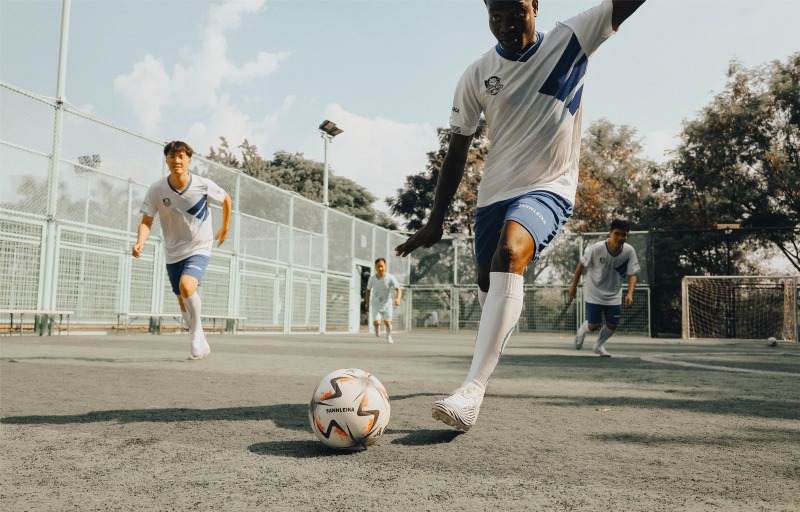
Why PVC Is a Practical Surface Material for Training Footballs
The outer material has a direct influence on how a football performs under everyday training conditions.
PVC is widely used in training football construction because it offers a practical balance between durability, flexibility, and cost.
For institutions purchasing footballs in volume, this balance is particularly important.
Abrasion Resistance for Rough Outdoor Training
School and academy training does not always take place on premium natural grass.
Players may train on:
- Artificial turf
- Hard outdoor fields
- School playgrounds
- Multi-purpose sports surfaces
- Rough grass pitches
- Community football fields
These environments can expose the football surface to significant friction.
A durable PVC outer layer helps the football withstand everyday surface contact, helping reduce premature cosmetic and functional wear.
A Practical Choice for Bulk Procurement
Schools and academies often need to purchase multiple footballs simultaneously.
Premium match footballs may provide advanced performance characteristics, but they are not always the most economical choice for routine drills.
For everyday training, PVC training footballs can provide an attractive balance between purchase cost and durability.
This makes them suitable for buyers looking for cost-effective training footballs rather than equipment designed exclusively for professional match use.
Shape Retention Matters More Than the Initial Price
A training football can still look acceptable while its internal performance gradually declines.
Repeated impacts and frequent inflation can place stress on the ball’s structure. If the ball loses its intended shape, players may notice inconsistent movement during passing, shooting, and ball control.
Stable Shape Supports Consistent Training
Good shape retention helps maintain more predictable ball behavior.
This is particularly useful for technical drills such as:
- Short passing
- Long passing
- First-touch exercises
- Shooting practice
- Ball control
- Dribbling
- Small-sided games
- Team formation drills
For youth academies, consistency is especially valuable because players develop technical habits through repetition. A durable training football that maintains its structure can therefore provide value beyond simply lasting longer.
Calculating the Real Cost of Training Footballs
The most useful way to compare football options is to calculate cost per use, rather than comparing purchase prices alone.
A simple formula is:
Cost per use = Purchase price ÷ Number of usable training sessions
For example, suppose a school purchases two different football options:
| Item | Football A | Machine-Stitched PVC Football B |
|---|---|---|
| Unit price | $18 | $22 |
| Usable training sessions | 30 | 50 |
| Cost per session | $0.60 | $0.44 |
Although Football B costs $4 more initially, its estimated cost per training session is lower.
The school may therefore spend more at the initial purchasing stage but less over the equipment’s useful life.
Note: The figures above are illustrative rather than guaranteed product lifespans. Actual service life depends on playing surface, frequency of use, inflation, storage, weather, and maintenance practices.
Bulk Purchasing Can Magnify the Savings
Consider a school that needs 100 footballs.
If a lower-priced ball requires frequent replacement, the annual equipment budget can increase significantly.
For example:
100 footballs × $18 = $1,800 initial purchase
If frequent replacement requires another 100 balls during the same period:
$1,800 × 2 = $3,600 annual purchasing cost
If a more durable training football reduces the replacement frequency, the initial unit price becomes less important.
This is why procurement teams should evaluate total cost of ownership, not just the lowest quotation.
Why Durable Training Footballs Are Ideal for Schools and Academies
Schools and academies have different equipment requirements from professional clubs.
Their priorities often include durability, consistency, affordability, and easy inventory management.
For School Physical Education Programs
Schools typically need footballs that can withstand repeated use by different groups of students.
A durable training football can support:
- Daily PE classes
- After-school football programs
- Student clubs
- School competitions
- Recreational activities
The ability to purchase footballs in bulk also simplifies equipment standardization across multiple classes.
For Youth Football Academies
Academies place even greater emphasis on repeated technical training.
Young players may complete hundreds of passes and shots during weekly sessions. A football used throughout these drills needs to withstand repeated impact while maintaining reliable shape and surface performance.
Academy training footballs with durable construction can therefore help coaches maintain consistent training equipment without constantly replacing damaged balls.
For Amateur Leagues and Community Programs
Community football organizations often operate with tighter equipment budgets.
A long-lasting soccer ball can reduce the frequency of emergency replacements and make the available budget go further.
This is especially valuable for organizations managing multiple teams or training groups.
Reduce Replacement Costs by Thinking Beyond Unit Price
For schools and football academies, the cheapest football is not necessarily the most economical football.
Frequent replacement creates several hidden costs:
- Repeated purchasing
- Shipping expenses
- Inventory management
- Equipment disposal
- Administrative workload
- Training interruptions
- Inconsistent equipment quality
A durable football can help reduce these costs by extending the useful period between replacements.
Machine-stitched PVC footballs combine reinforced construction and a practical outer material, making them a strong choice for routine training environments where footballs experience frequent use.
For buyers searching for durable training footballs for schools or a low-maintenance soccer ball bulk order, the most important question is not simply:
“How much does each football cost?”
Instead, ask:
“How much does each usable training session cost?”
That shift in perspective makes it easier to identify footballs that provide better long-term value.
FAQ About Machine-Stitched PVC Training Footballs
Are machine-stitched footballs suitable for school training?
Yes. Machine-stitched footballs can be a practical choice for school training because consistent stitching supports durability during frequent passing, shooting, and ball-control exercises.
Are PVC footballs durable enough for frequent training?
PVC can provide a durable and cost-effective outer surface for everyday training. Actual service life depends on the playing surface, frequency of use, storage conditions, inflation, and maintenance.
Why are durable footballs important for schools?
Schools often use the same equipment across multiple classes and training groups. More durable footballs can reduce replacement frequency and help control long-term equipment costs.
Are these footballs suitable for bulk orders?
Yes. Machine-stitched PVC training footballs are well suited to bulk procurement for schools, football academies, amateur clubs, and community sports organizations.
How can schools reduce football replacement costs?
Schools can reduce replacement costs by choosing durable construction, matching the football to the playing surface, maintaining proper inflation, storing balls correctly, and evaluating cost per use instead of only the initial purchase price.
What should buyers look for in training footballs?
Key factors include stitching quality, outer material, shape retention, playing-surface compatibility, expected service life, bulk pricing, customization options, and supplier production consistency.
Can training footballs be customized with a school or academy logo?
Yes. For bulk orders, customized footballs can typically be produced with organization logos, colors, designs, and other branding requirements, subject to the manufacturer’s customization capabilities and order specifications.


Add comment