
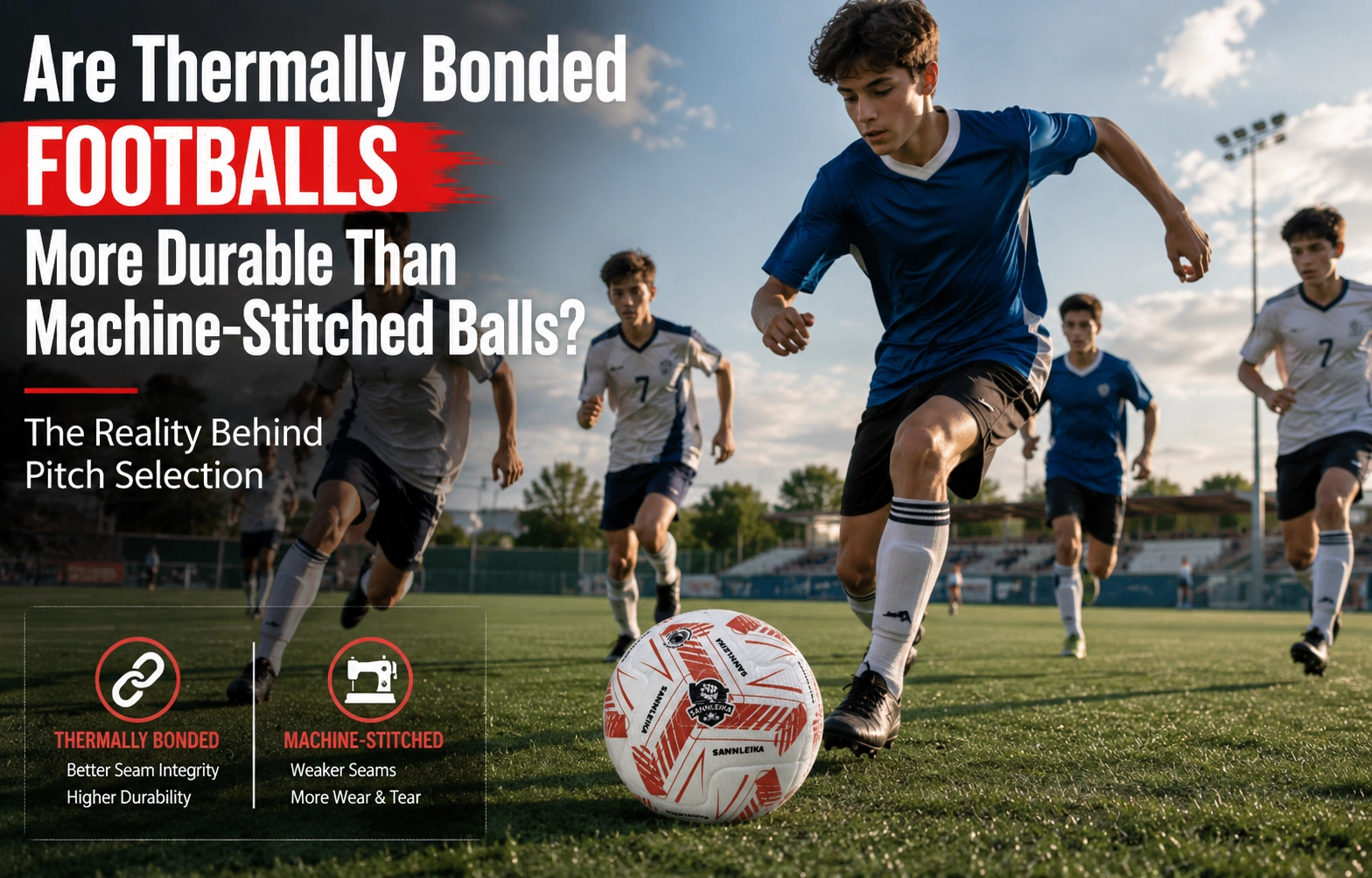
Are Thermally Bonded Footballs More Durable Than Machine-Stitched Balls? The Reality Behind Pitch Selection
Football players, amateur club equipment managers, and sports procurement directors often debate a fundamental gear question: “Are expensive thermally bonded footballs inherently more durable than traditional machine-stitched balls, or does pitch surface dictate real-world lifespan?”
While many assume that higher price points automatically guarantee longer durability across all playing conditions, real-world longevity depends heavily on pitch friction, moisture exposure, and construction mechanics. While machine-stitched balls rely on physical thread seams that can absorb water and fray over time, a high-quality thermally bonded football eliminates stitched seams entirely, creating a smooth, water-resistant outer shell.
This technical guide provides an objective evaluation of structural durability across different pitch environments, analyzes mechanical failure points, and outlines pitch-matching strategies when sourcing a thermally bonded football.
1. Structural Mechanics: Thermally Bonded vs. Machine-Stitched Footballs
Understanding how football panels are joined helps explain the differences between thermally bonded footballs and machine-stitched footballs. In particular, seam construction affects water resistance, shape retention, durability, and ball performance.
Thermal Bonding vs. Machine Stitching: Key Differences
| Performance Factor | Thermally Bonded Football (THB) | Machine-Stitched Football |
|---|---|---|
| Seam Construction | Panels are fused through heat and pressure | Panels are connected with high-tension thread seams |
| Water Absorption | Very low; typically less than 1% weight gain when wet | Higher because water can enter through needle holes |
| Shape Retention | Maintains a stable molded spherical structure | Shape can gradually change as seams stretch |
| Natural Grass Durability | Approximately 12–24 months under typical use | Approximately 6–12 months under typical use |
| Hard-Ground Performance | Bonded edges may experience greater abrasion | Threads may fray, while the core structure remains stable |
| Weather Resistance | Strong resistance to moisture penetration | More vulnerable to water and moisture exposure |
| Flight Consistency | More consistent shape and aerodynamic performance | Performance can change as the ball wears |
Water Resistance and Shape Retention
One of the biggest differences between the two construction methods is water resistance.
Machine-stitched footballs contain thousands of needle punctures along their seams. Therefore, when the ball is used in wet conditions, water can gradually penetrate through these openings.
As a result, the ball may absorb additional moisture and increase in weight. Over time, repeated exposure to water can also affect the internal carcass, stitching, and overall durability.
In contrast, a thermally bonded football (THB) uses heat and pressure to fuse the outer panels to the internal carcass. This construction minimizes open seam pathways and helps reduce water penetration.
Consequently, thermally bonded footballs can maintain a more consistent weight and shape during wet-weather play. They can also provide more stable rebound characteristics and ball flight on rain-soaked pitches.
Why Seam Construction Matters for Football Performance
Beyond water resistance, thermal bonding also contributes to long-term shape retention.
Because the panels form a bonded outer structure, the football can maintain its spherical geometry during repeated impacts. This stability helps support predictable ball control, rebound, and flight.
By comparison, machine stitching relies on physical threads to hold individual panels together. As the ball experiences repeated impacts, stretching and thread wear can gradually affect seam integrity and shape stability.
Therefore, for professional training, outdoor football programs, sports academies, and frequent-use applications, thermally bonded footballs can offer advantages in moisture resistance, structural consistency, and long-term performance.
Overall, the choice between thermal bonding and machine stitching should depend on the intended playing environment, usage frequency, weather exposure, and required durability.
2. Pitch Surface vs. Durability: Where Each Construction Excels
Durability cannot be measured in a vacuum—the playing surface directly determines wear patterns and lifespan:
Natural Grass & High-Quality AG Pitches (Ideal for Thermal Bonding)
On soft natural turf or modern FIFA-certified artificial grass, a thermally bonded football delivers superior durability (12–24 months of frequent match play). Without abrasive friction to wear down bonded panel seams, the protective outer coating resists surface scuffs while maintaining consistent roundness and flight stability.
Concrete, Asphalt, and Rough Street Grounds (Challenging for Bonded Panels)
On abrasive street courts or rough, non-infilled turf, high-impact friction can generate intense shearing stress along panel margins. While machine-stitched threads on concrete eventually fray and snap, their underlying panel structure remains joined until mechanical failure. For hard urban surfaces, high-abrasion machine-stitched balls or specialized hard-court thermal balls are recommended.
3. SANNLEIKA THB Thermally Bonded Football Engineering Features
SANNLEIKA manufactures professional-grade thermally bonded football systems engineered with specialized Thermally Heat Bonded (THB) technology for competitive match play and intensive team training:
Balanced 8-Panel Design for Precise Aerodynamics
Utilizing an advanced 8-panel configuration, SANNLEIKA THB footballs distribute weight evenly across the carcass. Reducing total seam length minimizes air resistance and eliminates mid-air wobble, delivering straight, predictable flight paths during long passes and powerful shots.
Textured 0.5mm PU Outer Layer with 3.20mm EVA Cushioning
-
Micro-Textured PU Surface: A specialized 0.5 mm textured Polyurethane outer skin enhances boot grip and wet-weather control while boosting aerodynamic stability.
-
Cushioned EVA Foam Layer: Backed by a high-density 3.20 mm EVA foam backing, the ball delivers soft touch, comfortable foot contact, and energetic energy transfer for high-velocity shots.
Low Water Absorption & Exceptional Shape Retention
Molded under precise thermal pressure, the casing maintains its roundness under repeated high-speed impacts. Near-zero water uptake ensures the ball remains lightweight and stable in wet conditions, matching FIFA Quality professional performance standards.
4. Strategic Sourcing Guide: Pitch-Matching Selection Matrix
Equipment managers and sports buyers should select football construction profiles based on target field conditions:
| Playing Environment | Recommended Ball Construction | Key Performance Requirement |
| Professional Matches / Natural Grass | THB Thermally Bonded (8-Panel) | FIFA Quality certification, zero water gain, true flight |
| Quality Artificial Turf (3G/4G AG) | THB Thermally Bonded (Micro-PU) | Exceptional shape retention, 3.20mm EVA cushioned touch |
| Multi-Surface Training / School Fields | Hybrid / Mid-Tier Thermally Bonded | Balanced durability, low moisture uptake, cost control |
| Asphalt / Street Courts / Concrete | Reinforced High-Abrasion Stitched | Thread-protected panels for high-shear impact |
Technical Summary
Evaluating durability across playing environments confirms that a thermally bonded football offers superior water resistance, aerodynamic flight accuracy, and shape retention on natural grass and modern artificial turf. While rough concrete surfaces demand specialized abrasion-resistant construction, thermally bonded balls provide extended lifespan and professional playability for competitive teams and training academies. SANNLEIKA specializes in manufacturing FIFA-standard thermally bonded footballs, THB match balls, and custom training equipment for global sports brands and commercial clubs.




Add comment