
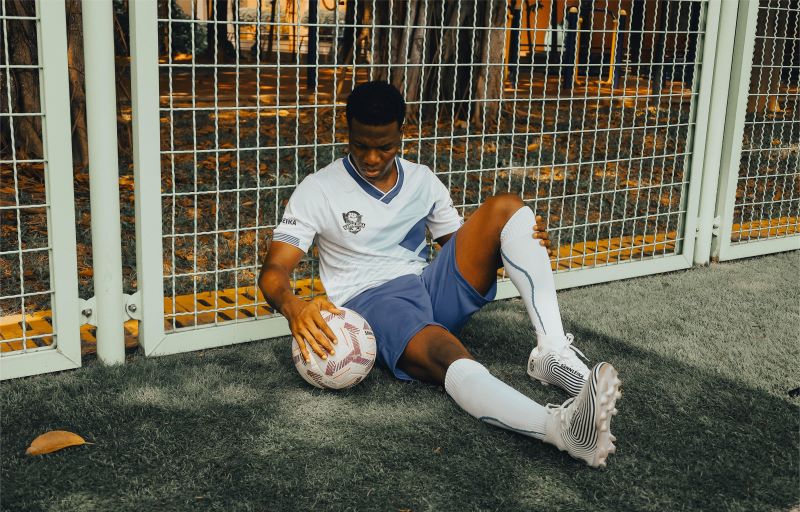
Tested by Concrete and Passion: How a TPU Shell Gives a Soccer Ball the Resilience of a Street Soul
In the hallowed cathedrals of professional football—the manicured grass of elite stadiums—the game is a thing of pristine beauty. But the true soul of soccer often lives elsewhere. It lives on the rough asphalt of urban parking lots, the abrasive concrete of neighborhood cages, and the sun-baked dirt of makeshift pitches. Here, the game is not played with delicate finesse, but with raw passion and a “street soul.”
In these harsh environments, a standard leather or cheap PVC ball is a temporary guest; it cracks, peels, and loses its shape under the friction of the ground and the heat of the sun. To survive the street, a ball needs more than just air; it needs armor. The emergence of TPU standard futsal balls and street-specific soccer balls has introduced a new “toughness” to the game. TPU (Thermoplastic Polyurethane) is the material that allows a ball to withstand the dual grind of concrete and unbridled enthusiasm, becoming a durable container for the memories of every goal scored in the “cages.”
1. The Urban Battlefield: Why Traditional Materials Fail the Street
Street soccer is a game of high friction. When a ball is kicked against a chain-link fence, dragged across coarse cement, or left out under the relentless summer sun, it undergoes a level of physical trauma that natural grass simply doesn’t inflict.
The Weaknesses of PVC and Leather
-
The Abrasion Crisis: Traditional PVC is often too brittle; under the high-speed friction of concrete, the outer “skin” tears away, exposing the inner stitching.
-
The Water/Heat Paradox: Leather, while premium, is porous. It absorbs moisture from puddles and expands under heat, leading to a “heavy” ball that loses its aerodynamic truth.
-
The Structural Collapse: On the street, a ball isn’t just kicked; it is crushed against walls. Without a resilient shell, the internal bladder eventually bulges, turning a sphere into an unpredictable oval.
2. TPU: The “Street Fighter” of Material Science
TPU (Thermoplastic Polyurethane) is not just “another plastic.” It is a high-performance elastomer that sits at the perfect intersection of rubber’s elasticity and plastic’s strength. In the context of TPU standard futsal balls, it acts as a protective exoskeleton.
Superior Abrasion Resistance
TPU possesses an incredibly high molecular density. When it rubs against a rough surface like asphalt, the material “yields” slightly and then bounces back rather than being worn away. It is the difference between a ball that “shreds” and a ball that “wears.” A TPU ball might show the honorable scars of a hard game, but its structural integrity remains uncompromised.
Tear Strength and “Self-Healing” Properties
Street Soul thrives on raw intensity and relentless impact. Therefore, TPU delivers high tensile strength against sharp urban edges. Even when fences scrape the ball, tears rarely spread. Moreover, the material preserves its knit under extreme stress. As a result, all panels stay firmly locked through thousands of strikes.
Weatherproof Resilience
Unlike PVC, which becomes “glass-hard” in the winter and “sticky” in the summer, TPU remains stable across a wide temperature range. It is non-porous and hydrophobic, meaning it won’t gain weight on a rainy day or crack under UV exposure.
3. The “Feel” of the Game: Low-Bounce Logic for the Cage
In the world of urban football, particularly in Futsal, the ball must behave differently. It needs to be “obedient.”
-
Low-Bounce Engineering: TPU standard futsal balls are often paired with a specialized stuffed bladder (often polyester or butyl with foam filling). This creates a “low-bounce” effect. On a hard concrete surface, a high-bounce ball is uncontrollable. The TPU shell provides the “grip” and the weight necessary for the ball to stay close to the player’s feet, allowing for the rapid-fire footwork that defines street mastery.
-
Tactile Feedback: Despite its toughness, TPU is soft to the touch. It provides a cushioned feel that protects the player’s foot during “barefoot-style” street play, absorbing the shock of a hard strike while maintaining a crisp, responsive “pop” upon contact.
4. The Ritual of the Grind: A Container for Memories
A TPU soccer ball is more than an athletic tool; it is a witness. In the urban “cages,” a ball is often the only thing that a group of friends shares.
-
The “Honorable Wear”: There is a specific aesthetic to a well-used TPU ball. As it weathers the concrete, the graphics may fade, and the matte finish may take on a slight sheen from the dust of the pitch. These aren’t defects; they are the “rings of a tree”—visual proof of hours spent in pursuit of the game.
-
Sustainability through Longevity: The most “green” soccer ball is the one you don’t have to replace every three months. By choosing TPU, players and community organizers invest in a product that endures multiple seasons of “madness,” reducing the waste cycle associated with cheap, disposable sports gear.
5. Strategic Choice: Why TPU is the Gold Standard for Schools and Clubs
For organizations managing urban pitches or school sports programs, the transition to TPU is a matter of logistical wisdom.
-
Cost-Per-Play Efficiency: While the initial cost of a TPU standard futsal ball may be slightly higher than a basic PVC ball, its lifespan is 3 to 4 times longer. This drastically lowers the “cost-per-game.”
-
Safety and Consistency: A ball that retains its shape and weight ensures a safer playing environment. No unpredictable bounces, no “heavy” water-logged strikes, and no sharp plastic flakes from a peeling surface.
-
Global Standard Compliance: Modern TPU balls are engineered to meet FIFA and international futsal standards regarding weight, circumference, and water absorption, ensuring that even “street” practice translates to professional-level skill development.
6. Conclusion: Long Live the Street Game
The game of soccer doesn’t need a stadium to be beautiful; it only needs a flat surface, a set of goals (even if they are just two backpacks), and a ball that can survive the friction of the real world.
The TPU standard futsal ball is the ultimate tribute to this “Street Soul.” It is a material that understands the grind of the concrete and the heat of the passion. It is a ball that refuses to quit, mirroring the resilience of the players who chase it until the streetlights come on. When you kick a TPU ball across a rough urban pitch, you aren’t just playing a game; you are engaging with a piece of engineering that was built to endure as long as your love for the sport does.





Add comment